


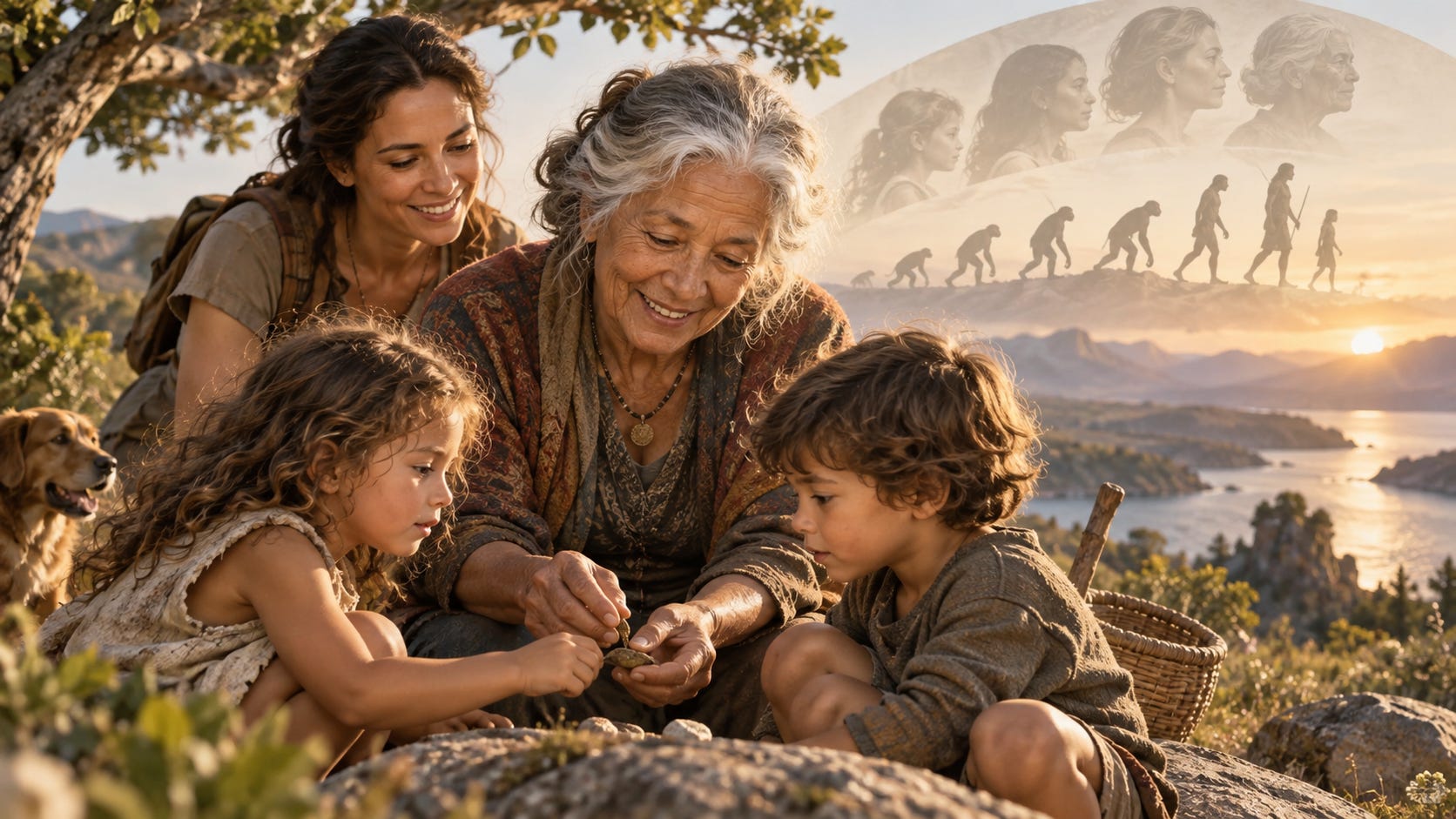
For as long as I can remember, menopause was presented as an ending.
You lose estrogen.
You lose progesterone.
You lose your periods.
You lose your fertility.
And underneath all of that, quietly, persistently, is a much more damaging message that nobody says out loud:
You lose your value… (BS)
I believed that story for longer than I’d like to admit. Even as a naturopath. Even as someone who had spent years studying women’s health. The cultural conditioning runs that deep.
Then I came across something that stopped me completely.
I was listening to Dr. Mindy Pelz, one of the most prominent voices in women’s hormonal health right now. I like her for many of her wisdom pieces, though we are on two opposite sides of the spectrum. She promotes meat and even at times, questionable options of processed (jerky) meat that is crazy to me… whilst I work with plants only, because it can be done and it can be done right!
But on one of her videos, she mentioned something called the “Grandmother Hypothesis” in the context of menopause.
I had to stop what I was doing….Because if she was right, everything we’ve been taught to feel about this transition is built on the wrong story.
And it started , of all places, with killer whales.
The evolutionary mystery nobody talks about
Here’s something that should be bigger news than it is.
From a purely evolutionary standpoint, menopause doesn’t make obvious sense.
Most mammals remain capable of reproduction for the majority of their adult lives. Evolution tends to favour whatever keeps a species reproducing. So why would nature produce a creature, a human woman, who spends a significant portion of her adult life after her reproductive years have ended?
For decades, scientists couldn’t fully explain it.
Then they noticed something extraordinary.
We’re not alone.
A small number of toothed whale species, killer whales, belugas, narwhals, false killer whales, and short-finned pilot whales, also have females who live for many years after they stop reproducing.
Think about what that means.
Two completely different species. Evolutionary paths that separated tens of millions of years ago. And both arrived at the same biological strategy: females who outlive their fertility by decades.
That is not a coincidence.
That is evolution trying to tell us something.
Maybe the point was never just reproduction
This is where it gets beautiful.
The Grandmother Hypothesis proposes something that sounds simple but is actually profound.
At a certain stage of life, a female may contribute more to the survival of her family, and her genes, by supporting the children and grandchildren already alive, than by continuing to produce more offspring.
Her biological contribution doesn’t disappear.
It changes.
A major study published in Nature in 2024 looked at toothed whale species and found something remarkable. Menopause in these animals didn’t evolve by shortening the reproductive lifespan. It evolved by extending the overall female lifespan, creating more years after reproduction ends.
More years to contribute.
More years to protect.
More years to guide.
The evolutionary story isn’t “you are finished.”
It’s “you are needed for something else.”
The menopausal grandmother who kept her family alive
I want to tell you about killer whale grandmothers, because I think about them often.
Killer whales live in tight, intensely social family groups. And older females, the post-reproductive ones, hold something the younger animals simply cannot manufacture overnight.
Experience.
They know where the food has been in hard years. They remember what happened last time conditions changed. They can guide the group. They can share resources. They carry decades of ecological memory that keeps the whole family alive.
Researchers have actually measured this.
Studies of resident killer whale populations found that having a grandmother alive significantly increased the survival of her grandchildren.
And the survival benefit was greatest when the grandmother was no longer reproducing herself.
She wasn’t producing babies.
She was keeping everyone else’s babies alive.
Let that land for a moment.
Wisdom is biological capital
Here’s the part I want you to sit with.
We live in a culture obsessed with female youth. Our reproductive years are celebrated. Our younger bodies are marketed. Fertility is wrapped up in femininity in ways most of us don’t even notice until menopause arrives and we suddenly feel invisible.
But evolution doesn’t measure value through a cultural lens.
Evolution measures what helps a group survive.
And in highly social species, the kind that depend on cooperation, memory, and intergenerational knowledge, an older female is not a liability.
She is an asset.
She has survived hard things.
She has made mistakes and learned from them.
She has accumulated knowledge that younger members of her community haven’t had time to gather yet.
That knowledge is not decorative.
It can keep people alive.
And I want to be honest with you here
I’m not going to romanticise menopause.
I lived through perimenopause myself. I know what it can take from you, sleep, clarity, patience, the feeling of being at home in your own body. I stopped looking in the mirror for eight months. I didn’t recognise myself.
That was real.
And the symptoms are real.
Sleep disruption. Temperature dysregulation. Mood changes. Brain fog. Cardiovascular shifts. Bone and muscle changes. These deserve to be taken seriously, treated properly, and not dismissed.
So when I say menopause can represent power, I’m not saying the symptoms should be pushed through or minimised.
I’m saying something much bigger than that.
A woman’s reproductive capacity and a woman’s value are not the same thing.
And evolutionary biology gives us very good reason to question why our culture has spent so long treating them as if they were.
The grandmother may have helped build humanity
The Grandmother Hypothesis is one of several complementary evolutionary explanations for why menopause exists. Scientists are still investigating the full picture. But substantial research across anthropology, evolutionary biology, and animal behaviour suggests that older women can meaningfully increase the survival and reproductive success of their descendants.
Contemporary evolutionary models increasingly combine grandmother effects with other mechanisms, including reduced reproductive competition between generations, and the value of accumulated knowledge during periods of scarcity.
That nuance makes the story richer, not weaker.
Because it tells us that menopause may not be an evolutionary error at all.
It may have survived across generations because older females continued contributing something important enough to matter.
Not another pregnancy.
Memory. Knowledge. Resources. Guidance. Protection. Care.
And suddenly “menopausal” sounds different
Imagine if this were the story girls grew up hearing.
Not:
You’re young. You’re fertile. You’re valuable.
Then:
You’re older. You’re menopausal. You’re fading.
But instead:
Your biology moves through seasons. During one season, your body may have the ability to create life. During another, everything you’ve learned from living becomes one of the most important things you can contribute.
I love that.
Because menopause doesn’t erase the woman you were at 25.
It contains her.
Along with the woman you became at 30. And 35. And 40. And 50.
Every difficult thing you survived.
Every skill you built quietly, over years.
Every person you’ve loved.
Every version of yourself you’ve had to let go of to become who you are now.
That’s the thing about wisdom.
You cannot rush it.
You have to live long enough to earn it.
And perhaps that’s one of the most honest ways I know to reframe menopause.
Not as nature quietly removing a woman’s usefulness.
But as evidence that female usefulness was never limited to reproduction in the first place.
A note on the science: The Grandmother Hypothesis is one of several complementary evolutionary explanations proposed for prolonged post-reproductive life. A major 2024 comparative study published in Nature found that menopause in toothed whales evolved through longer overall female lifespan rather than shortened reproductive lifespan. Separate research in killer whale populations has demonstrated measurable survival benefits associated with post-reproductive grandmothers.
If this resonates with you, I write about this every week inside Cycles Wellness — the science, the real experience, and the practical tools to help you navigate this transition on your own terms.